1. Bluesky Feeds /
  2. Joy 💙🦸 /
  3. Space 🔭🌌

A Space for Space, The vast unknown, infinite source of Energy and Matter

Feed on Bluesky

Feeds Stats

  • 💙 Liked by 25 users
  • 📅 Updated 7 months ago
  • ⚙️ Provider skyfeed.me

Space 🔭🌌 Likes over time

Like count prediction
The feed Space 🔭🌌 has not gained any likes in the last month.

Feed Preview for Space 🔭🌌

Martin Bracken - FRAS -CitySpaceAstro
@cityspaceastro.bsky.social
about 9 hours ago
Jupiter 90 minute time lapse using IR720 pass filter. C6 - ASI585MC #astronomy #astrophotography
Video thumbnail
Play button
25
106
983
ArtButMakeItSports
@artbutmakeitsports.bsky.social
about 11 hours ago
Starry (K)night and the Astronauts, by Alma Thomas, 1972 (rotated), 📸 by @StephChambersPhoto
0
36
340
James Davenport
@jradavenport.com
about 13 hours ago
This is plainly what’s happening to NASA, and why NSF is being gutted. Yes, your favorite galaxy might get a glossy image from JWST next year, but the field of astronomy is actively being torn to shreds and we’re not even being honest about it with ourselves!

I just wish someone would be honest and say “we are ending civilian science in favor of science that is focused on serving national security and war”

2
21
102
Daniel Pomarède
@pomarede.bsky.social
about 21 hours ago
NASA’S PUNCH Releases Refined Images of Eruptions from the Sun science.nasa.gov/blogs/pu…. Video shows coronal mass ejections erupting from the Sun’s surface from Oct. 21 to Nov. 12, 2025. Comet C/2025 A6 (Lemmon) is seen at the top, Venus at the left, and Mercury to the right of center. 🧪🔭
Video thumbnail
Play button
4
16
53
SETI Institute
@setiinstitute.bsky.social
about 15 hours ago
#PPOD: NASA’s Hubble Space Telescope captured an uncommon sight – the death of a low-mass star – in this image of the Calabash Nebula released on Feb. 3, 2017. Here, we can see the star going through a rapid transformation from a red giant to a planetary nebula... 🧪 🔭 👩‍🔬
A long, gourd-shaped planetary nebula seen in orange with a white center piece stretches from upper left to lower right. At each end, the interstellar gas has been compressed by a shock wave, shown in blue, with the lower wave being much larger than the upper. Numerous blue and white stars are scattered throughout the image.
1
11
49
Space Telescope Science Institute
@stsci.edu
about 16 hours ago
We’re going back to the late 1900s! 🧓🏻 In 1994, astronomers found conclusive evidence for a supermassive black hole in the center of the giant elliptical galaxy M87 in Hubble images: go.nasa.gov/43c9C1d 🔭 🧪
Gas disk in the nucleus of active galaxy M87, as captured by the Hubble Space Telescope using the Wide Field Planetary Camera 2. A grainy orange haze fills the frame. In the center is a bright nucleus surrounded by a spiral-like structure, the disk. A thin stream of orange, clumpy material, a jet, emerges from the nucleus and continues diagonally to the upper right corner of the frame. A pullout shows more details in the area around the nucleus.
2
5
49
Steve Brown - astronomy and astrophotography
@sjbastro.bsky.social
about 10 hours ago
Star trails shot centred on Polaris from 16-17 December. Just over 3 hours of star movement. 😀 #Astronomy #Astrophotography
Long circular streaks of light formed by the movement of the stars during a long exposure. Exposure taken from 21:33 to 00:35 UT on 16-17 December 2025.
3
10
43
Peter Lewis
@peterlewis55.bsky.social
about 13 hours ago
It's the last New Moon of 2025 tonight and my first Moon photo montage of 2025 so here's a selection of December's 'Cold Moon' #astronomy #astrophotography @stormhour.com @photohour.bsky.social
3
5
38
Aurélien Genin
@astroaure.bsky.social
about 10 hours ago
🔭 Le télescope spatial SPHEREx de la NASA a complété son premier scan complet de la sphère céleste 🤩 Et grâce à sa caméra, cette image est composée de 102 couleurs ! En utilisant des combinaisons différentes, on peut révéler les étoiles ou la poussière par exemple www.jpl.nasa.gov/news/nas….
Image du ciel capturée par SPHEREx montrant principalement les étoiles et galaxies
Image du ciel capturée par SPHEREx révélant principalement la poussière et le gaz chaud
1
8
29
Nic Kleinhans
@thebignic.bsky.social
about 23 hours ago
#Astrophotography My first Horse Head Nebula. I never thought to be able to make such a picture in my life.
Horse Head Nebula on a pink background with bright white stars overall
1
2
23
Mission spatiale Euclid 🇫🇷
@euclid-france.bsky.social
about 21 hours ago
🎉 Très belles vacances à tous et bonne année 2026 ! 🥳 Cette année sera celle de la première "grosse" publication de données du satellite (DR1), en octobre, et des premiers résultats cosmologiques de la mission ! 🌌 Crédit : ... ⬇️ #science #astro #astronomy #astrophoto #Holidays #2026
1
3
19
Melina Thévenot🏳️‍⚧️
@melina-iras07572.bsky.social
about 12 hours ago
Two globular clusters in the Andromeda #Galaxy. Image with #JWST NIRCam (F150W, F277W). program: www.stsci.edu/jwst-program...
Two star clusters. Left: Bol 228, which is larger and right: Bol 279.
1
2
18
Ian George
@scannerian1.bsky.social
about 21 hours ago
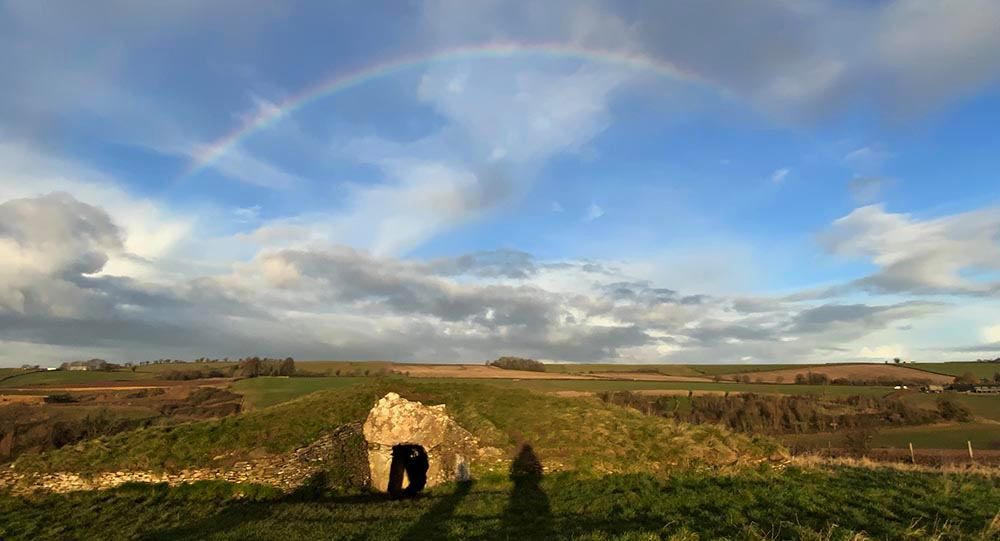
The entrance to Stoney Littleton long barrow. The midwinter sunrise aligns with the passageway. #hailtheancestors #rainbow #burialmound #longbarrow #neolithic #druids #astronomy #winter #solstice #photography
0
2
14
Space.com
@space.com
about 11 hours ago
The recent #geminid #meteorshower did not disappoint as #skywatchers and #stargazers were dazzled by the #meteors streaking across the #nightsky. Read more about the meteor shower and #astrophotography on our website. #image #picoftheday #photo #astronomy #science #spacescience#photography
0
1
13
Scott Horton
@robertscotthorton.bsky.social
about 12 hours ago
This NASA/ESA Hubble Space Telescope image features a glittering blue dwarf galaxy called Markarian 178 (Mrk 178). The galaxy, which is substantially smaller than our own Milky Way, lies 13 million light-years away in the constellation Ursa Major (the Great Bear).
0
2
11
Dr. Ryan French
@ryanjfrench.bsky.social
about 13 hours ago
New #SolarFlare research!!! The Solar Orbiter spacecraft is an ESA/NASA mission on an elliptical orbit around the Sun. At its closest approach to our local star, it captures high resolution images of the Sun's atmosphere – including of solar flares! ☀️ (a thread, 1/9)
1
1
9
BadAstroPhotos.com
@badastrophotos.bsky.social
about 3 hours ago
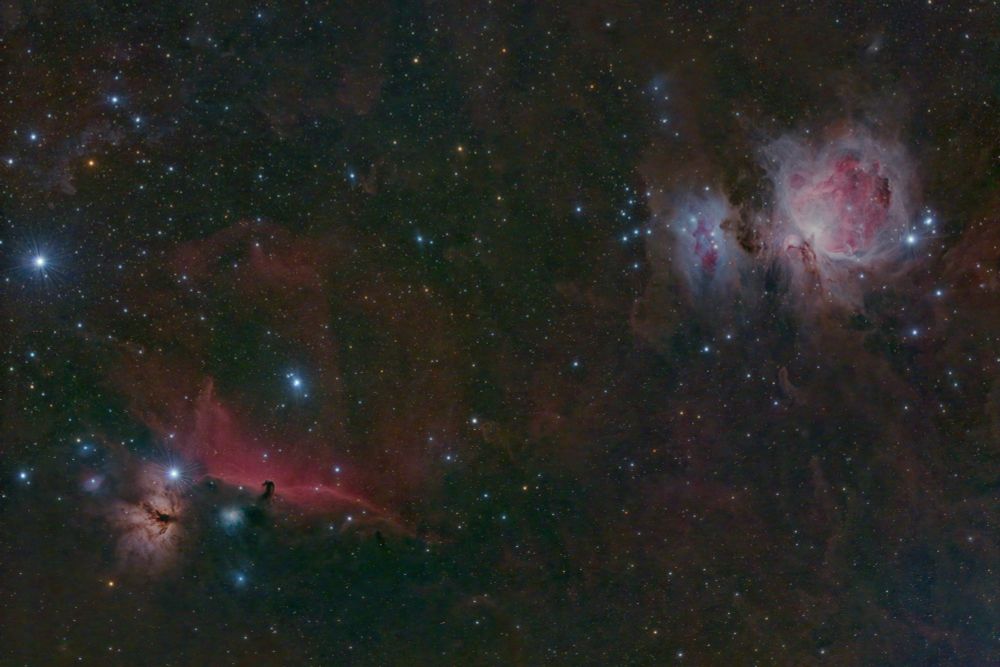
Orion Belt to Sword, the Flame, Horsehead, and Great Nebula of Orion. 
 4 hours of #NBOSC exposures on 2025-12-12 under Bortle 3 skies from Bad Wolf Ranch, Texas. WO RedCat 250/51mm, ASI2600 MC camera, 251 30" exposures 2x drizzle stacked. Original image is 100 MegaPixels. #astrophotography
0
3
8
Nasa Astronomy Hourly Pictures
@nasadailypicbot.bsky.social
about 17 hours ago
NASA Astronomy Hourly Picture - 2024-04-18: Facing NGC 1232 #Astronomy #NASA #Space
From our vantage point in the Milky Way Galaxy, we see NGC 1232 face-on. Nearly 200,000 light-years across, the big, beautiful spiral galaxy is located some 47 million light-years away in the flowing southern constellation of Eridanus. This sharp, multi-color, telescopic image of NGC 1232 includes remarkable details of the distant island universe. From the core outward, the galaxy's colors change from the yellowish light of old stars in the center to young blue star clusters and reddish star forming regions along the grand, sweeping spiral arms. NGC 1232's apparent, small, barred-spiral companion galaxy is cataloged as NGC 1232A. Distance estimates place it much farther though, around 300 million light-years away, and unlikely to be interacting with NGC 1232.  Of course, the prominent bright star with the spiky appearance is much closer than NGC 1232 and lies well within our own Milky Way.
0
2
7
Kim, Bestie of Bunzy, Co-CEO Execubetch™️
@easybakedoven.bsky.social
about 4 hours ago
I don't understand why NASA can get clear photographs of Asteroid Bennu (pictured), which is further away and traveling at the same speed as 3IAtlas but can't get a decent photo of 3IAtlas which is 10x Benny's size
Video thumbnail
Play button
3
0
5
ufo-uap.news
@ufo-uap-news.bsky.social
about 4 hours ago
The UAP EP 177 podcast delves into the Simpkinson NASA Archive UFO photo, revealing potentially authentic and groundbreaking findings from author Ed Wilson's research on astronaut-taken UFO images. #ufo #uap #aliens #ovni #ufosky
UAP EP 177 Is NASA Covering Up this UFO Photo? – 98KUPD – Arizona's Real Rock

98kupd.com

UAP EP 177 Is NASA Covering Up this UFO Photo? – 98KUPD – Arizona's Real Rock

The Simpkinson NASA Archive UFO photo may be the most clear picture of a flying saucer ever taken that many people have never even heard of before. Author and h

0
0
5
Nasa Astronomy Hourly Pictures
@nasadailypicbot.bsky.social
about 15 hours ago
NASA Astronomy Hourly Picture - 2006-07-27: NGC 7331 and Beyond #Astronomy #NASA #Space
Spiral galaxy NGC 7331 is often touted as an analog to our own Milky Way. About 50 million light-years distant in the northern constellation Pegasus, NGC 7331 was recognized early on as a spiral nebula and is actually one of the brighter galaxies not included in Charles Messier's famous 18th century catalog. Since the galaxy's disk is inclined to our line-of-sight, long telescopic exposures often result in an image that evokes a strong sense of depth. The effect is further enhanced in this well-framed view by the galaxies that lie beyond this beautiful island universe. The background galaxies are about one tenth the apparent size of NGC 7331 and so lie roughly ten times farther away.
0
2
4
⚒ José Simões ⚒
@josesimoes.bsky.social
about 23 hours ago
Astronomy Picture of the Day Long Shadows of the Montes Caucasus apod.nasa.gov/apod/ap25121...
0
0
4
@mjlinde.bsky.social
about 5 hours ago
A collage created for the beautiful nebula photography of... @joegarrity.bsky.social
1
0
3
Mike Lewinski
@wildernessvagabonds.com
about 10 hours ago
Here's the full #timelapse for December 18-19, 2025 from Crestone, Colorado USA The sound track is Time Rebel by The Polish Ambassador & The Diplomatic Scandal, used under a Attribution-Noncommercial-Share Alike 3.0 United States License #astronomy #astrophotography
Time is Not Money - December 18-19, 2025 time lapses

youtu.be

Time is Not Money - December 18-19, 2025 time lapses

YouTube video by Mike Lewinski

0
0
3
Nasa Astronomy Hourly Pictures
@nasadailypicbot.bsky.social
about 11 hours ago
NASA Astronomy Hourly Picture - 2017-07-18: Thunder Moon over Pisa #Astronomy #NASA #Space
What's wrong with this picture?  If you figure it out, you may then realize where the image was taken.  The oddity lies actually in one of the buildings -- it leans. The Leaning Tower of Pisa has been an iconic legend since shortly after its construction began in the year 1173.  Now part of a UNESCO World Heritage Site, folklore holds that Galileo used the leaning tower to dramatically demonstrate the gravitational principle that objects of different mass fall the same.  Between the Leaning Tower of Pisa on the right and Pisa Cathedral and the Pisa Baptistery  on the left, a full "Thunder" moon was visible last week when the image composite was taken.  Using modern analyses, the tower has been successfully stabilized and, barring the unexpected, should hold its present tilt for the next 200 years.    Indonesia: New APOD Mirror Site in Indonesian
0
0
3